
Disclaimer
I personally do not advocate any process or procedure contained in any of my human publications. Information presented is not intended to provide legal, lawful, financial or medical advice, diagnosis, treatment, cure, nor prevent any disease. Views expressed are for educational purposes only. I surround, protect, purify and make harmless the following information.
The Myth of Catching a Cold
Dr. Patrick Coles
Aug 22, 2026
Most people are taught that a cold is a viral infection the immune system must fight off. The runny nose, the congestion, the low-grade fever, the fatigue — these are framed as symptoms of the body under siege.
In Toxin Sequestration Theory (TST) we read the same events differently. A cold is better understood as a short-term, body-initiated clearance and containment program.
When the toxic or oxidative burden exceeds what quieter defenses can handle, the body escalates. It increases mucus production to trap and move material out, sometimes raises temperature to support mobilization and excretion, shifts circulation and lymphatic flow, and temporarily redirects resources. What we experience as “catching a cold” is largely that coordinated response in action.
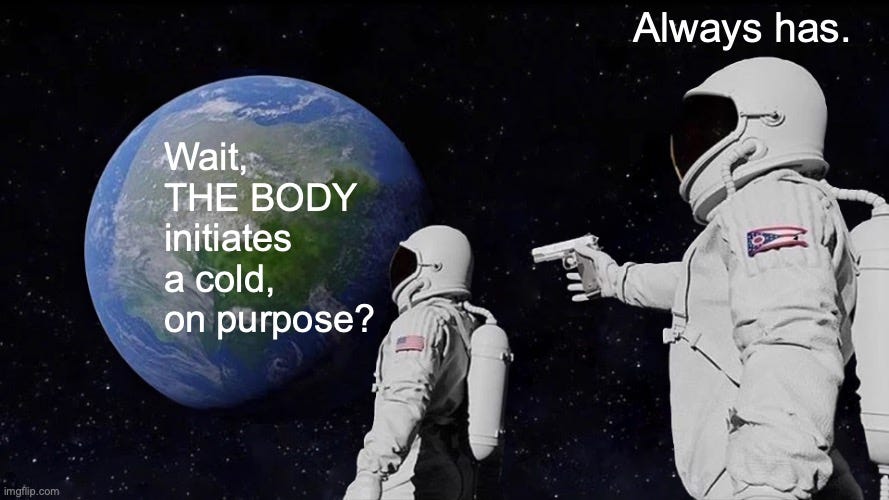
This view aligns directly with the patterns already covered in the fever and mucus posts. Both are protective tools. A cold simply recruits them together, often along the respiratory route, when the terrain has been pushed past its current capacity. Microbes may be present and may even participate, but they are secondary to the underlying load that made the clearance event necessary.
The everyday evidence is straightforward
People who adopt a strict low-toxin diet, especially carnivore, frequently report that colds and flu-like episodes become rare or disappear. This is not because the diet “boosts the immune system” in the conventional sense. It is because the baseline toxic burden stays low enough that the body rarely needs to launch a full clearance response. The same protective machinery remains available; it is simply called upon far less often.
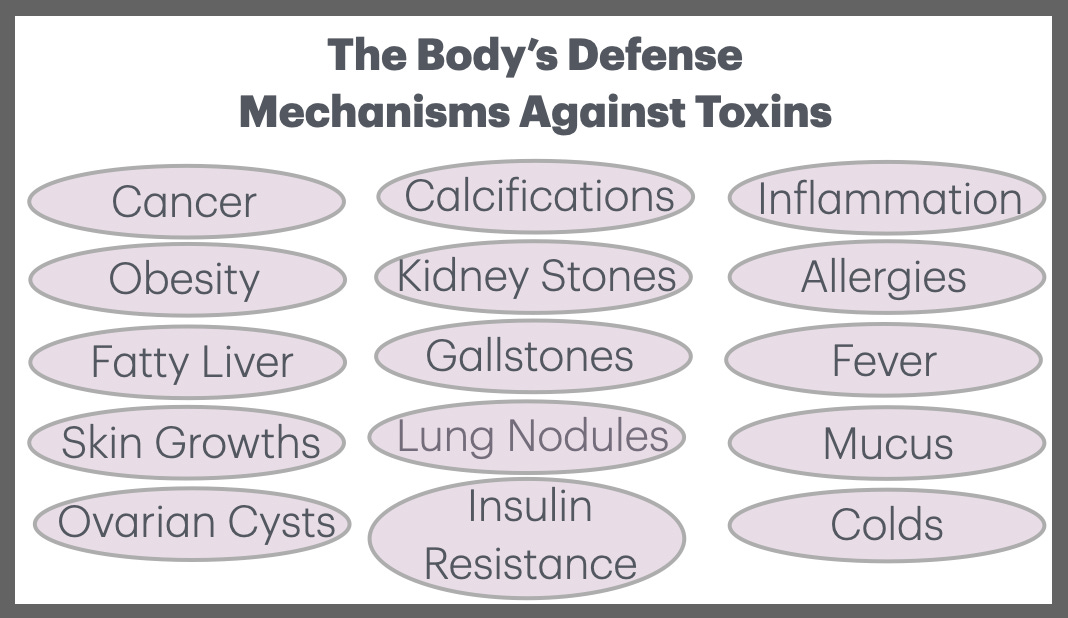
In what follows, we will unpack what a cold actually is in this framework, why the body chooses this response, how it fits the broader hierarchy of protective adaptations, and what it means for how we support — rather than suppress — the process. This also means that “colds” add to our growing list of the body’s defense mechanisms against toxins.
What a Cold Actually Is
In the conventional story, a cold is an infection. A virus enters the respiratory tract, multiplies, and the immune system responds. The congestion, mucus, mild fever, and fatigue are treated as signs that the body is losing a battle with the germ.
In Toxin Sequestration Theory a cold is something else: a coordinated, time-limited clearance and containment program that the body itself initiates when quieter defenses are no longer enough.
The program has several recognizable parts. Mucus production rises so that material can be trapped and moved out of the airways. Secretions increase. Lymphatic and circulatory activity shift. Energy is redirected away from ordinary activity and toward the clearance effort, which we experience as fatigue and the need to rest. In some cases a low-grade fever appears, raising temperature in the same way described in the fever post — supporting mobilization and excretion rather than simply “fighting a virus.”
The respiratory tract is a logical place for this to happen. It is an outward-facing surface with a built-in exit route. The body can move a burden toward the mucus layer and then out of the body without having to build a more expensive, longer-term vault.
The microbes that are often found during a cold may be present and may even take advantage of the changed terrain. They are not required for the core logic. The decisive event is that the toxic or oxidative load has crossed a threshold. The body then turns on a visible, short-term response to contain and clear what the everyday systems could not handle quietly.
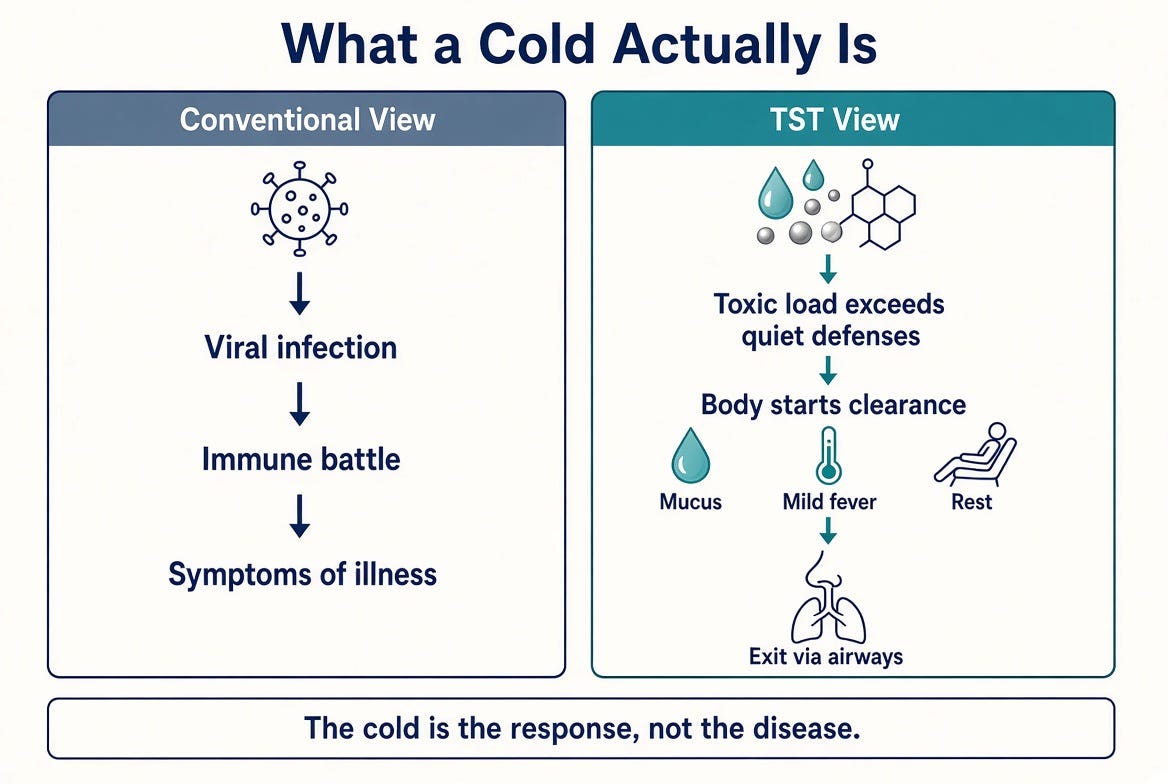
That is why a cold should not be treated as the disease itself. The disease, in this framework, is the overload that made the response necessary. The cold is the body’s attempt to deal with it. Continues at https://patrickcoles.substack.com/p/colds-are-not-an-attack-they-are
We do NOT catch the flu
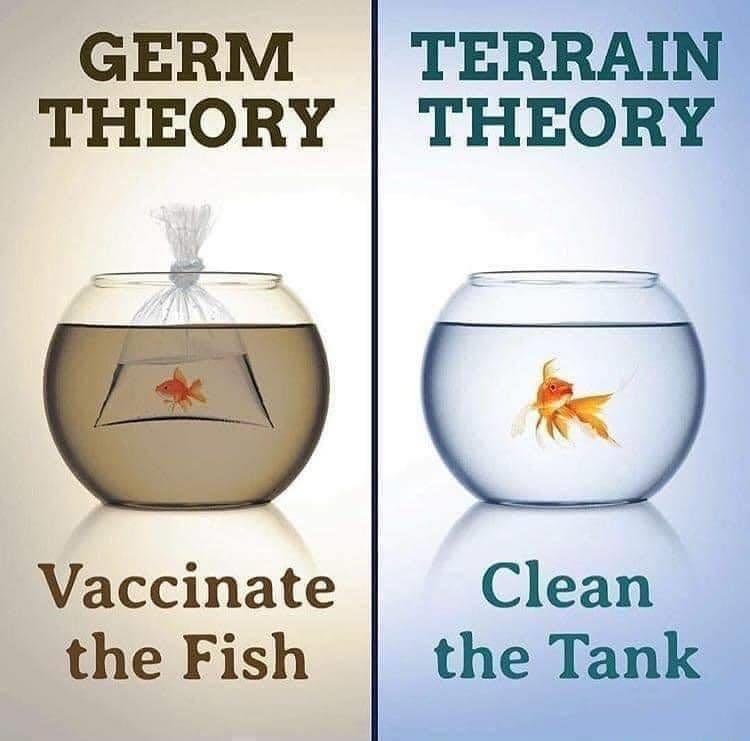
This is the point we need to reconsider. The germ theorists have pulled a sleight of hand on the population. We went from thinking that a cold is transmissible, to assuming it is transmitted by secretions of the symptomatic organs.
If it is not the secretions or the bugs…then, what are we “catching”?
The Rosenau Experiment & The Mystery of the 1918 Influenza Pandemic
Behind a paywall at remnantmd.com below
The Rosenau Experiment (1918-1919) is one of the most fascinating and perplexing scientific investigations conducted during the Influenza Pandemic of 1918, a deadly outbreak that killed an estimated 50 million people worldwide. Led by Dr. Milton Joseph Rosenau and conducted by the U.S. Public Health Service and the U.S. Navy, this experiment aimed to determine how influenza spread and whether it could be intentionally transmitted under controlled conditions.
Surprisingly, despite direct exposure to infected patients, nasal and throat inoculations, and even injections of infected blood, not a single volunteer developed the flu. This shocking result challenged prevailing assumptions about how the virus was transmitted and left scientists baffled.
This page provides an invaluable resource for historians, educators, genealogists, and researchers seeking to understand:
✔ The scientific and medical challenges of studying a fast-moving pandemic
✔ How early epidemiologists attempted to isolate the influenza virus
✔ The broader implications of failed transmission experiments in understanding viral infections read and whether it could be intentionally transmitted under controlled conditions. Continues at https://www.ggarchives.com/Influenza/TheRosenauExperiment-1918-1919.html
Source with a paywall https://www.remnantmd.com/p/can-you-catch-a-cold
2021: Disease causing viruses do not exist
In Apr 2021, Dr. Stephan Lanka proved viruses are component parts of the cell that turn their entire metabolism over to the common cell and can leave the cell. Outside the common cell they help other cells in that they transfer construction and energy substances. Any other function of theirs has never been observed. Those actual viruses, which have been scientifically demonstrated to exist, are performing in the very complex processes of interactions of different cells, a helping, a supporting and in no case a destructive role.
In the case of diseases, neither in the diseased organism nor in a bodily fluid has any structure, which you could characterize as a virus ever been seen or isolated. The proposition that there is any illness causing virus whatsoever is a transparent swindle, a fatal lie with dramatic consequences. Continues at https://www.ourgreaterdestiny.ca/p/virus-fraud-disclosed-through-cpe
Breaking the Spell by Thomas S. Cowan
Feb 10, 0222
Tom Cowan’s booklet, Breaking the Spell, serves as a follow-up to our book, The Contagion Myth, providing new information to support our claim that the existence of the SARS-CoV-2 virus is unproven and that no convincing evidence exists to indicate that the cellular structures called “viruses” are pathogens.
As Cowan points out, the published literature does not contain any evidence of any virus directly isolated from any bodily fluid from even one person suffering from a so-called “viral” illness—such as chicken pox, rabies, measles, AIDS or Covid-19—and that’s not because separation and isolation are impossible to do. Scientists are able to isolate identical particles (called bacteriophages) from bacterial cultures and show pure samples of these particles under an electron microscope. These particles are morphologically identical, made of exactly the same proteins, with identical genetic sequences.
Why have scientists not done this with viruses? The answer they give: “There is not enough virus to find.” Yet, these scarce viruses are supposed to be the ferocious agents that are making us sick!
If it is not possible to collect enough viruses to study them, how do scientists “prove” that viruses make us sick? They do this through a procedure that produces a “cytopathic effect” in cells. Breaking the Spell also elaborates on other frauds including the PCR test, Covid vaccines and even current models of cell morphology. Continues at https://www.westonaprice.org/book-reviews/breaking-the-spell-by-thomas-s-cowan/#gsc.tab=0
Conclusion
Dr Tom Cowan explains why he thinks virology is a hoax. [2 mins video] https://substack.com/@maxwang1/note/c-260583352
Without prejudice and without recourse
Doreen Agostino
Our Greater Destiny Blog
virology