
Disclaimer
I personally do not advocate any process or procedure contained in any of my human publications. Information presented is not intended to provide legal, lawful, financial or medical advice, diagnosis, treatment, cure, nor prevent any disease. Views expressed are for educational purposes only. I surround, protect, purify and make harmless the following information.
Why is the industry hiding insects behind numbers?
By Michelle Perro, MD
Sep 13, 2026
European Union
Repost
For the past 25 years I’ve been fighting for disclosure. Your right to know what is in your food. Choice. Risk vs. benefits. And yet, the fight continues daily to inform you so that you can protect your children. This image inspired this article today:
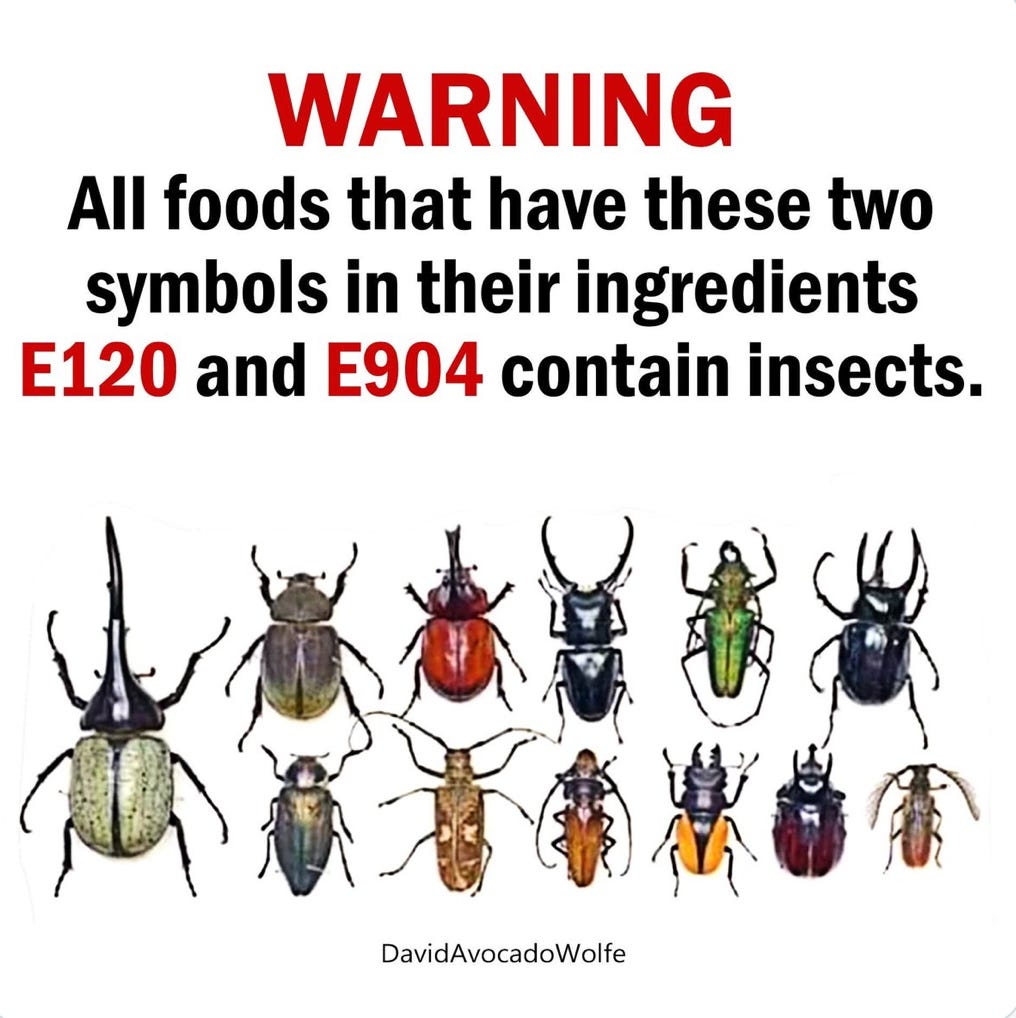
The Image That Started It
You’ve probably seen this warning circulating: “All foods that have these two symbols in their ingredients E120 and E904 contain insects.” It’s true. And it’s worse than you think. I went down the rabbit hole…
E120 (carmine/cochineal) is made by crushing roughly 70,000 female cochineal insects (Dactylopius coccus) to produce just one kilogram of red dye. It colors your child’s strawberry yogurt, red candies, fruit juices, sausages, and even some jams.
E904 (shellac) is a resin secreted by the lac bug (Kerria lacca), scraped off tree branches and melted into a glossy coating. It shines your child’s chocolate candies, coats their chewing gum, waxes the apples in the produce aisle, and even coats pharmaceutical tablets and vitamin supplements.
The image is correct. But here’s what’s missing from the picture: these ingredients are hidden behind anonymous codes by design.
The Labeling Problem: Anonymity by Design
The EU regulation defining E120 literally states it’s obtained from “the dried bodies of the female insect Dactylopius coccus.” It even acknowledges that “proteinaceous material derived from the source insect” may be present in commercial products. Yet the ingredient list just says “E120.”
No parent reads “E120” and thinks “crushed insects.” That’s the point.
The food industry knows exactly what’s in your child’s food. They just don’t have to tell you in words you’d understand. “E120” is a code designed to obscure, not to inform.
The same applies to shellac. Look for these aliases on labels:
Carmine, cochineal, cochineal extract, natural red 4 (E120)
Confectioner’s glaze, resinous glaze, shellac (E904)
Beeswax (E901 which is also insect-derived, often overlooked)
Why This Matters Most for Children
This is where the story gets urgent. Children are the primary consumers of the products where these additives are most concentrated (candy, fruit yogurts, juice drinks, and coated snacks). And their developing immune systems are uniquely vulnerable.
The Allergy Problem Is Documented, Not Theoretical
Research on cochineal dye allergy has documented anaphylaxis (the most severe allergic reaction) from ingestion of foods and drinks containing carmine. The EU was forced to mandate label declarations for potential allergic reactions back in 2000, and the FDA updated labeling rules in 2011 after severe cases were reported. In Japan, the Consumer Affairs Agency issued warnings after multiple anaphylaxis cases.
Here’s the critical part for parents: the allergic reactions are caused by insect-derived contaminating proteins, not the dye itself. A 38-kDa protein from the cochineal insect is thought to be the primary allergen.
And there’s documented cross-reactivity with:
House dust mites (Dermatophagoides species)
Storage mites
Crustaceans (shellfish)
Children allergic to dust mites or shellfish (which is a huge problem) may react to carmine-containing foods. The Finnish study on carmine allergy found that approximately 25% of carmine-sensitive patients had no dust mite or storage mite reactions, meaning they developed primary carmine sensitization. Continues at https://michelleperromd337477.substack.com/p/the-insects-hiding-in-your-childs
Companion to: Making Our Children Well
https://gmoscience.org/wp-content/uploads/2026/09/InsectsinChildsFood.pdf
End of repost.
Source https://nothingnewunderthesun2016.com
Carmine Color (E120): Insect Dye, Safety, and Foods
Carmine is approved as a food colorant in the United States (as a color additive exempt from certification), the European Union (E120), Australia, New Zealand, Canada and most major markets globally. There is no country-level ban. Continues at https://www.ingredicheck.app/blog/carmine-the-insect-derived-red-dye-hiding-in-your-food
What countries eat bugs/insects 2026
The idea of eating insects dates back thousands of years. Although the practice is least common in Europe, Canada, and the United States, the eating of insects is commonplace throughout much of the rest of the world, particularly in Africa and parts of Asia and South America. Continues at https://worldpopulationreview.com/country-rankings/what-countries-eat-bugs
What Foods Are They Putting Crickets In?
July 17, 2026
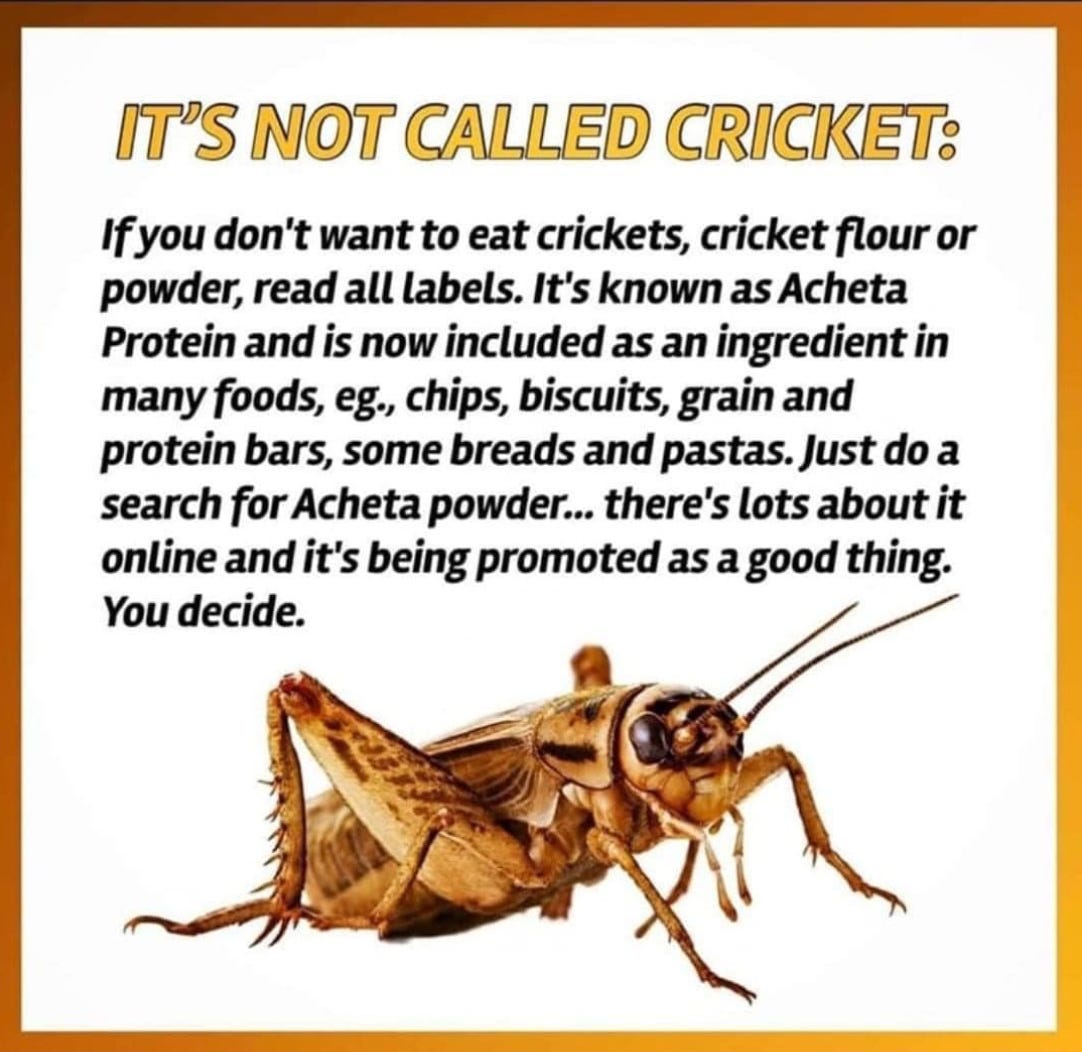
Cricket powder, also known as Acheta powder or Acheta protein, is a protein-rich flour made from ground crickets. It is often used in various food products, including cricket cookies, tortilla chips, protein bars, and all-purpose flour with nutty flavors. Crickets are the fourth most popular edible insect worldwide, and their high protein per volume makes them easy to farm. Cricket flour is also used in oatmeal and baked goods due to its neutral taste. Canadian grocery chain Bitty Foods sources crickets from farms in Ohio, Georgia, central California, and Montreal, Canada, with another farm set to open in Minneapolis.
https://blog.entomologist.net/what-foods-are-they-putting-crickets-in.html
Edible insect sector in Canada and the United States
Aug 14, 2023
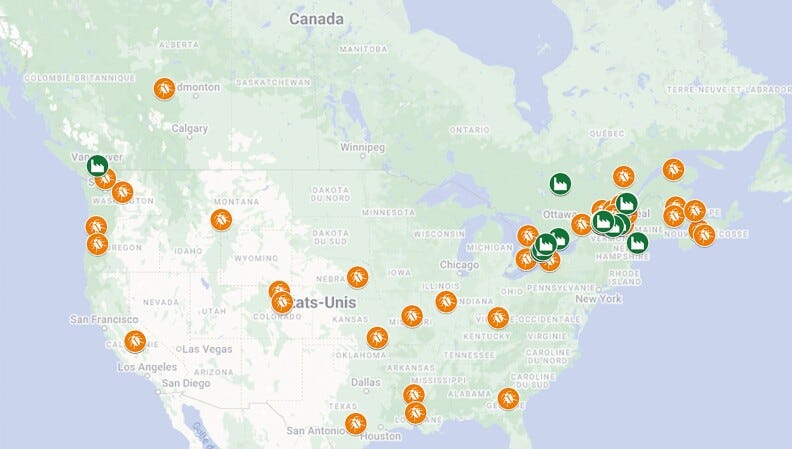
Map of edible insect producers (orange beetle, excluding producers of live insects for the pet market and research centers) and processors (green facility) in Canada and the United States.
Continues at https://pmc.ncbi.nlm.nih.gov/articles/PMC10425141/
EU/USA/Canada - Edible insects as functional foods
Apr 21, 2025
In Canada, regulatory provisions allow food items with a documented history of traditional consumption elsewhere in the world to be sold without additional regulations, provided they undergo the novelty determination process. Consequently, various insect species have been classified as non-novel foods, and the Canadian government has officially recognized this ingredient as having a history of safe consumption.
Existing guidelines in both Europe and the USA mandate that insects for human consumption must be farmed in authorized facilities and must not be sourced from the wild. This controlled environment allows for better hygiene management and minimizes contamination risks. Continues at https://foodcomplianceinternational.com/industry-insight/scholarly-articles/5324-eu-usa-canada-edible-insects-as-functional-foods-bioactive-compounds-health-benefits-safety-concerns-allergenicity-and-regulatory-considerations
Edible Insect Allergy in Humans
Allergen Source
Major Allergens
Cross-Reactivity
Allergic Potential
Common Symptoms
https://majorfoodallergens.com/edible-insects/
Bon Appétit
Without prejudice and without recourse
Doreen Agostino
Our Greater Destiny Blog
insects
I’m pretty sure insect powder is in more than one can imagine. Food labels don’t necessarily require listing ingredients below a certain percentage. All those insect farms and processing plants that cropped up a few years ago are not standing idle.
And in biology class they told us that the human digestive system cant handle insect proteine