
Disclaimer
I personally do not advocate any process or procedure contained in any of my human publications. Information presented is not intended to provide legal, lawful, financial or medical advice, diagnosis, treatment, cure, nor prevent any disease. Views expressed are for educational purposes only. I surround, protect, purify and make harmless the following information.
Key risk summary
For intelligent and energy-autonomous wearable and implantable biosensors.
Biocompatibility: Immune rejection, inflammation, and cytotoxicity from nanomaterials.
Performance: Signal drift, biofouling, and motion artifacts reduce diagnostic accuracy.
Power: Limited lifespan of micro-batteries and safety risks of wireless energy harvesting.
Security: Data privacy breaches and AI-driven diagnostic errors.
AI-generated answer. Please verify critical facts.
https://search.brave.com/search?q=risks+Intelligent+and+energy-autonomous+wearable+and+implantable+biosensors+&source=web&conversation=09a18a8dcaf3516a7e3d04357d5d11e47bbd
Posted by William Cody Nalbach
Source https://substack.com/@onepartyfreedom/note/c-350209247
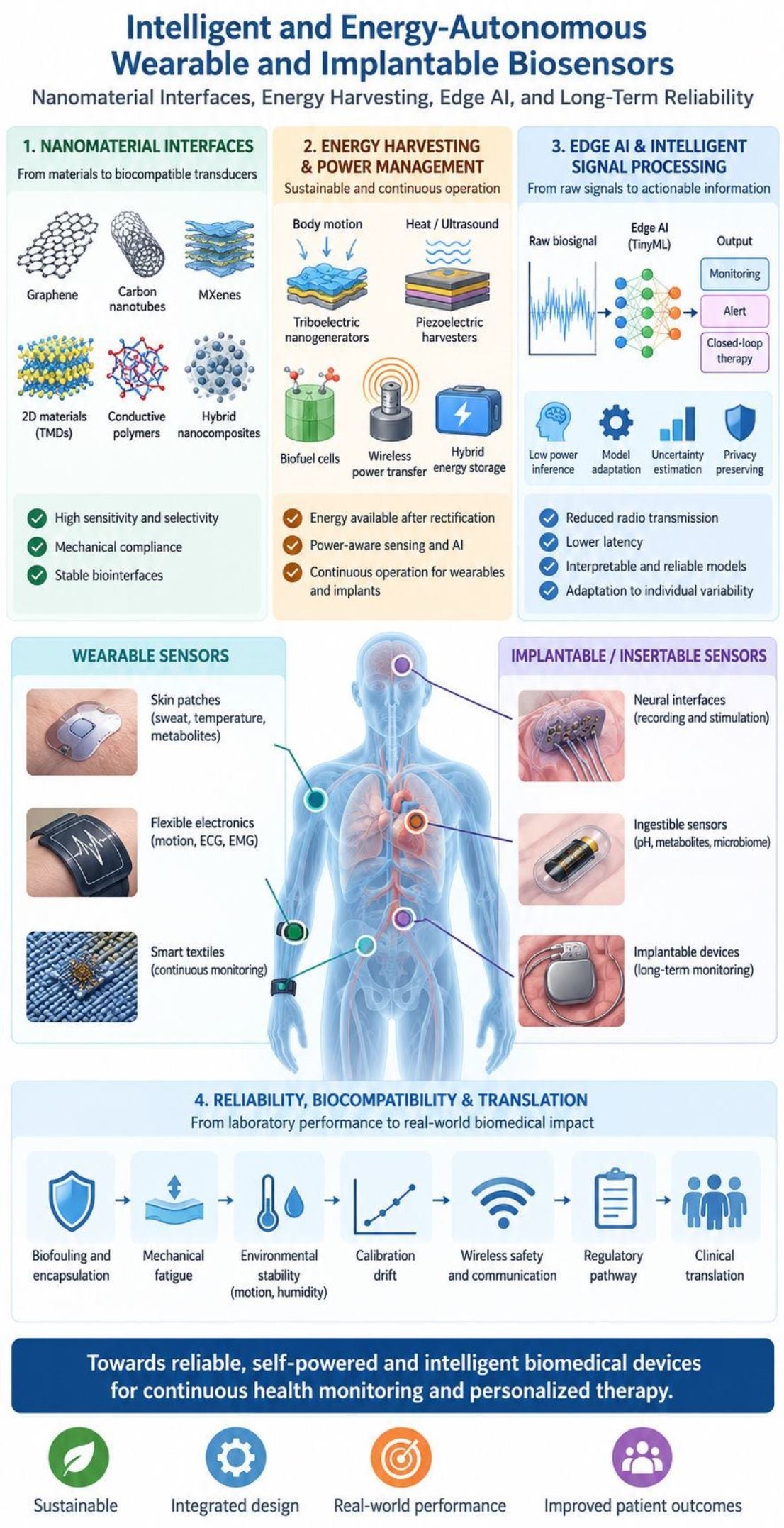
Intelligent and Energy-Autonomous Wearable and Implantable Biosensors: Nanomaterial Interfaces, Energy Harvesting, Edge AI, and Long-Term Reliability
by Stefano Bellucci
Sept 2026
Abstract
National Institute of Materials Physics, Atomistilor 405A, 077125 Măgurele, Romania
Wearable and implantable biosensors are becoming small distributed biomedical systems rather than isolated transducers. Continues at https://www.mdpi.com/2306-5354/13/10/1129#
Continuous Glucose Monitors - diabetics
Continuous Glucose Monitors (CGMs) are the primary patches used to test blood sugar levels, measuring glucose in interstitial fluid (the fluid between cells) rather than blood. These patches typically last 7 to 14 days and transmit data wirelessly to a smartphone or receiver.
Key types and features include:
Freestyle Libre: Worn on the back of the upper arm for 14–15 days; requires scanning with a reader or phone.
Dexcom: Worn on the abdomen or arm for 10 days; provides real-time automatic alerts.
Non-Invasive Prototypes: Emerging technologies use sweat analysis, hydrogel microneedles, or spectroscopy to monitor glucose without piercing the skin, though these are largely in research or early development phases.
Over-Patches: Adhesive stickers (e.g., Peelz, CURAD) are available to secure existing CGM sensors to the skin for 10–15 days.
Most widely available patches require a prescription, though some FDA-approved CGMs are now available over-the-counter without one for type 2 diabetes management.
AI-generated answer. Please verify critical facts.
Continues at https://search.brave.com/search?q=patches+to+test+blood+sugar+levels&source=desktop&conversation=09a1d78b443e9b7005eb171d6db5a0cba039
More than just a patch
A visiting relative in their 80s with diabetes and from out of town, wore Dexcom’s G7 patch unaware the patch was an electrochemical biosensor. We visited a large drugstore chain to purchase a kit to finger prick. We were told those kits are no longer available; they sell only the patches. [Doreen]
https://dexcompdf.s3.us-west-2.amazonaws.com/en-us/G7-CGM-Users-Guide.pdf#page=12
Without prejudice and without recourse
Doreen Agostino
Our Greater Destiny Blog
biosensors