
Disclaimer
I personally do not advocate any process or procedure contained in any of my human publications. Information presented is not intended to provide legal, lawful, financial or medical advice, diagnosis, treatment, cure, nor prevent any disease. Views expressed are for educational purposes only. I surround, protect, purify and make harmless the following information.
Power outage
By Ryan Penn
Take Action Canada
Oct 21, 2026
A realistic timeline based on how past events actually unfolded:
2003 Northeast blackout,
Hurricanes Katrina and Maria,
2021 Texas freeze,
Research on disaster behaviour.
The first few days are driven by stored reserves running out, not by chaos. How bad things get depends mostly on how long the outage lasts and whether outside help arrives.
First 24 hours: Normalcy bias “It’ll be back soon”
Food
Most people assume a short outage. Early buying is modest, mostly water, batteries, bread and snacks.
Stores that open without power can’t scan or take cards, so many close or sell cash-only at the door.
Food spoilage starts. A closed fridge keeps food safe for about 4 hours. A full freezer lasts about 48 hours and a half-full one about 24.
Water
Taps usually still work because water towers and reservoirs are gravity-fed.
Treatment plants and pumps switch to backup generators if they have them.
High-rise buildings lose water quickly above the floors that city pressure can reach without pumps.
If you live in an apartment ask if they have an emergency water plan, if they have a backup generator and how long will it last.
Supplies, fuel and medicine
Gas stations can’t pump without electricity, so the few with generators get long lines.
Cell towers run on battery backup, typically 4 to 8 hours. After that, coverage becomes patchy.
Hospitals run on generators. People who depend on home medical equipment, like oxygen concentrators and CPAP machines, are the first to need help.
Money
Cards, ATMs and mobile payments stop working. Cash becomes the only way to pay almost immediately.
Most people have very little cash on hand, often under $100.
48 hours: Reality sets in
Food
Refrigerated and frozen food is gone. People cook on BBQs, which leads to a spike in carbon monoxide poisonings from indoor grills and generators.
Grocery stores carry only about 3 days of stock under just-in-time delivery. With no trucks arriving, shelves are thin, especially water, canned goods, baby formula and batteries.
Rationing and purchase limits appear.
Water
Backup generator fuel at water and wastewater plants start running low without resupply.
Boil-water advisories are issued, but many people have no way to cook or boil.
Supplies, fuel and medicine
Fuel is essentially unavailable except at a few stations, with multi-hour lines.
Pharmacies can’t process prescriptions electronically. People who need insulin, dialysis or other daily medications begin to face real risk.
Phones die. Car chargers become the lifeline, which burns the fuel people have left.
Money
Some bank branches may open with manual withdrawal limits. Lines form.
Cash starts losing value against goods. Prices at the few places still selling rise sharply.
72 hours: The critical threshold
This is why emergency agencies say to plan for 72 hours of self-sufficiency. It’s roughly when stored reserves in homes, stores and systems all run out at once.
Food
Store shelves are empty. Most households have eaten through their fresh and easy food and are on pantry staples.
Formal food distribution may begin if government or aid groups can mobilize, but coverage is uneven.
Water
This is the biggest danger point. Municipal pressure may drop or fail as generators run dry.
Sewage lift stations fail, so toilets stop working and sanitation becomes a public health problem.
Bottled water is gone from stores.
Save grey water [from body washing, tooth brushing, cooking etc. to flush toilets].
Use 5 gallons pails lined with kitty litter or outhouse lime from a garden centre as a toilet.
Supplies, fuel and medicine
Communications are largely down. Rumours fill the gap, and battery or hand-crank radios become the main source of news.
Generator fuel is the most sought-after resource.
Nursing homes and hospitals begin evacuating or triaging if they aren’t resupplied.
Money
Barter emerges informally: fuel, water, batteries, cigarettes, alcohol and medications.
Banks remain closed or strictly limited, a run on remaining cash is likely when branches do open.
Social order:
Research consistently shows that people mostly cooperate in the first days. Neighbours share and panic is less common than movies suggest. Strain grows after about day 3 as resources vanish, and looting tends to concentrate on stores rather than homes.
1 week: New, harsher normal
Food
Households without stockpiles depend on aid distribution points, which are often crowded and irregular.
Hunting, fishing, foraging and garden produce start to matter in rural areas.
Vulnerable groups struggle most: the elderly, people with young children and people with dietary medical needs.
Water
Water comes from aid deliveries, rain collection, pools and natural sources.
Waterborne illness such as diarrhea and dysentery rises from untreated water and failed sanitation.
Supplies, fuel and medicine
Deaths from interrupted medical care start to rise. In major disasters, these indirect deaths often exceed deaths from the event itself. After Hurricane Maria, most of the roughly 3,000 deaths came in the weeks and months afterward.
Heat or cold exposure becomes deadly depending on the season.
Hygiene supplies run out, including soap, diapers and feminine products.
Money
Local economies are largely barter- and favour-based.
Many people may begin leaving the affected area if they have fuel and somewhere to go.
2 weeks: Split outcomes
The picture diverges sharply depending on whether outside help arrives.
If aid is flowing (typical for regional disasters):
There are fixed distribution points for food water, and shelters are set up.
Partial power returns to critical infrastructure first: hospitals, water plants and fuel terminals.
Banks reopen with limits. Emergency cash assistance or credit programs begin.
If aid is limited (widespread or national-scale collapse):
Food insecurity becomes serious for anyone without stores or land.
Disease becomes a major threat from contaminated water, poor sanitation and crowded shelters.
Communities organize informally, with neighbourhood watches, shared cooking and local councils.
People move toward cities with aid, or away from cities toward rural food sources.
1 month: Recovery or entrenchment
Recovery path:
Supply chains restart in stages. Stores reopen with limited stock and higher prices. Power and communications are restored region by region. The money system returns, but many people face job loss, debt and depleted savings. Mental health effects peak around this point.
Prolonged path (like Puerto Rico after Maria, where some areas waited nearly a year for power):
There’s a two-tier society: those with generators, fuel, cash or connections, and everyone else.
The informal economy and barter become established.
The population declines through outmigration.
Chronic illness deaths accumulate, and public health infrastructure is badly strained.
Main takeaway: the system fails in predictable order
Cash and communications go first (hours), then fresh food (day 1–2), then store stock and fuel (day 3), then water and sanitation (day 3–7), and then medical continuity (week 1+).
A household with two weeks of water, food, cash, medications and a way to cook and stay warm or cool is insulated from nearly every stage above. https://takeactioncanada.ca/
Controlled chaos
The following online information is likely the predator class informing humans about what they’re planning next and/or fear porn, to keep humans cycling in low vibratory frequency, void of logic and playing small to sustain this dark construct.
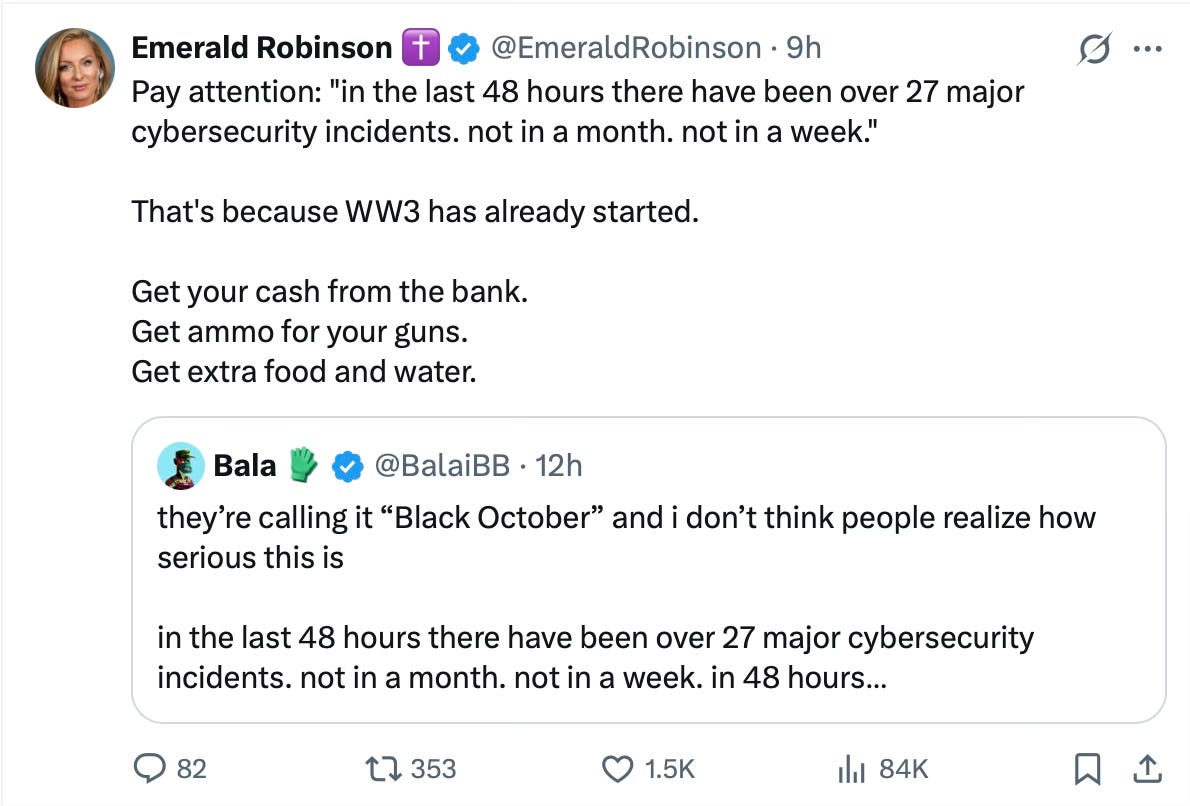
Black October? Multiple Warnings On Social Media To Prepare For Unspecified Disruption: Basic Lists Here
By Celia Farber
Oct 22, 2026
Repost
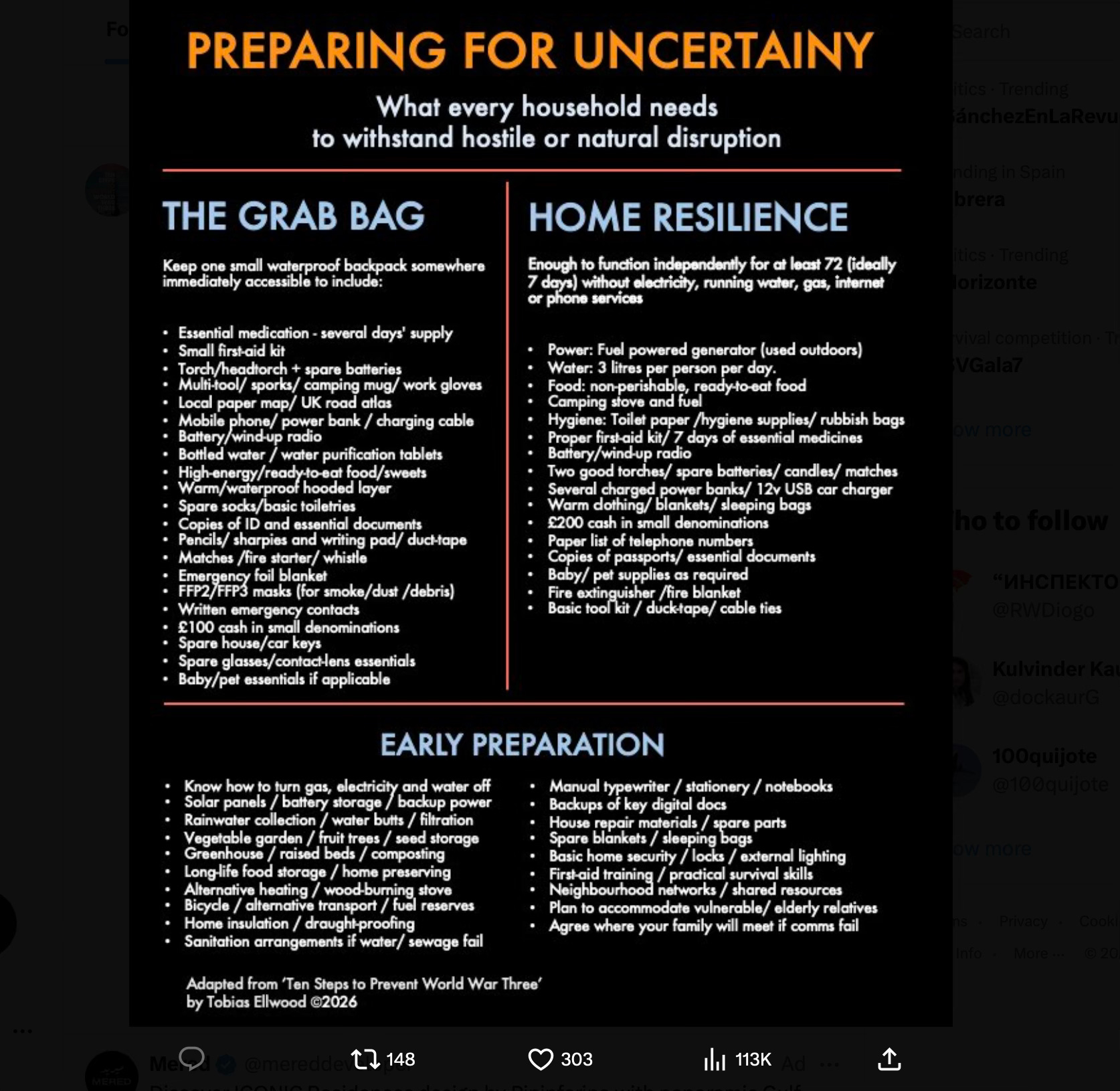
Black October: Major Cyber Incidents Flood the Last 48 Hours
Oct 22, 2026
The volume and severity of these events mark one of the most intense periods in recent cybersecurity history. Continues at htps://mobygeek.com/ict-news/black-october-major-cyber-incidents-flood-the-last-48-hours-16492

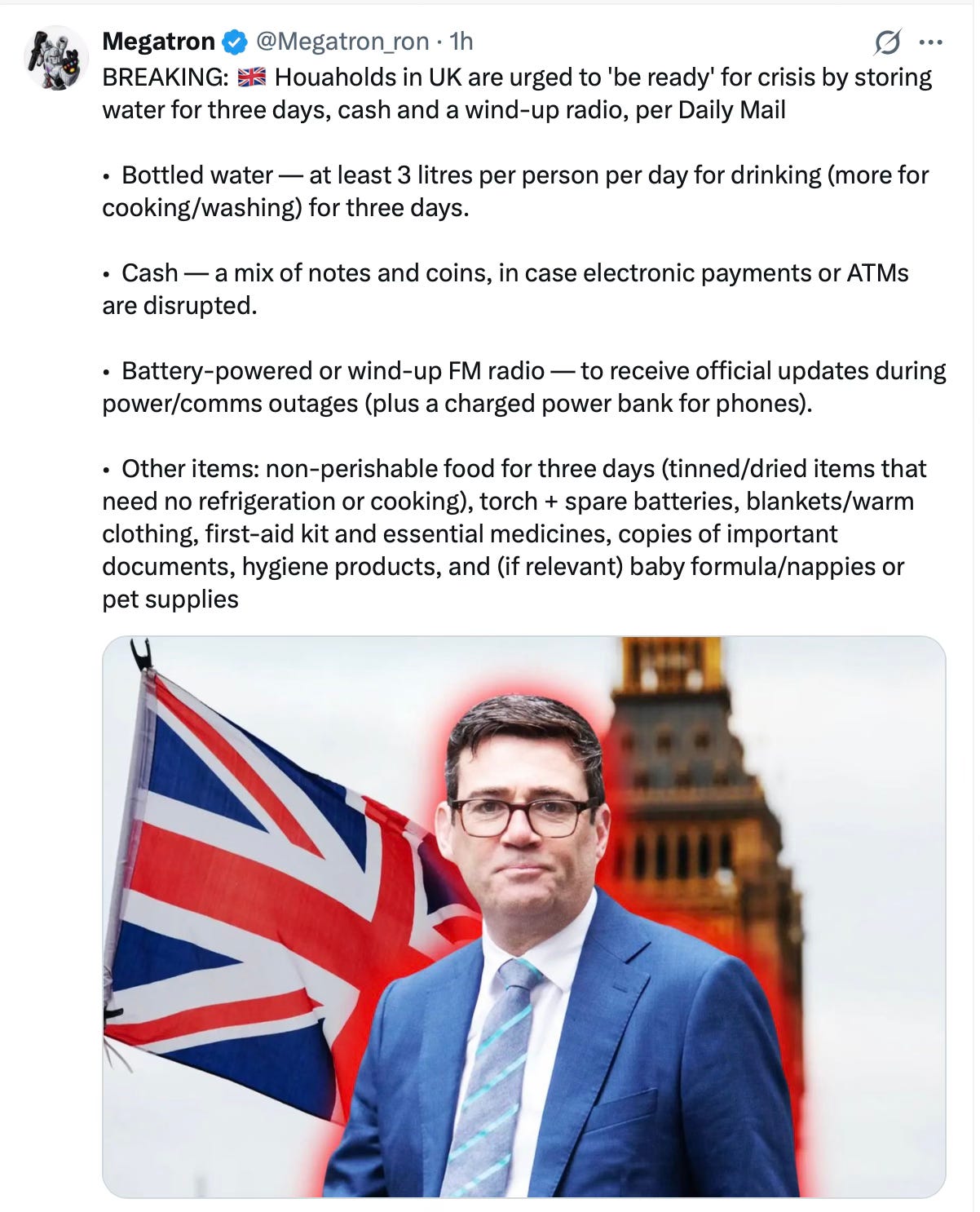
UK households urged to prepare for emergencies and ‘attacks’ in new government guidance
Oct 22, 2026. Wes Streeting is urging the public to prepare for extreme weather, cyber attacks, and war. Continues at https://www.independent.co.uk/news/uk/home-news/be-ready-checklist-government-cyberattack-emergency-kit-b3071646.html
Controlled response
What matters most is how each of us responds b/c the frequency of human emotion, like a boomerang, returns a matching response. Knowing this invites gratitude for preparation that may or may not be necessary. If unnecessary we can be grateful. If necessary we are prepared and can be grateful for that b/c gratitude raises our frequency.
Without prejudice and without recourse
Doreen Agostino
Our Greater Destiny Blog
emergencypreparation