
June 05, 2026 Update
I was introduced to AI Detector recently, so I just inserted text from https://gabrielrealityofficial.substack.com/p/the-neuroscience-of-letting-go into https://app.gptzero.me/
The response reads | Chance this entire text is...
AI 100%
Mixed 0%
Human 0%

Your thoughts?
Neuroscience of letting go
Gabriel
Apr 01, 2026
Why you cannot think your way out of what you will not release, what rumination is doing to your brain at the structural level, and the biological mechanism behind actually moving on. Excerpts only …
The mechanism is what matters
If you understand what your brain is actually doing when it refuses to let something go, you stop pathologizing yourself for the inability to just move on and start working with the biology instead of against it.
The ex you still think about eighteen months later. The version of your life you planned that didn’t happen. The thing someone said three years ago that still surfaces at 2 am. The failure you intellectually accepted and emotionally cannot put down.
These are not character weaknesses. They are your brain doing exactly what it was built to do, in a context where those built-in tendencies are working against you rather than for you.
Understanding the difference between those two things is where actual release begins.
Why the Brain Refuses to Let Go
Your brain is a prediction machine before it is anything else.
Every experience you have, every relationship you build, every plan you invest in, gets encoded not just as a memory but as a predictive model. A set of expectations about how reality is organized, what follows what, what is safe and what is threatening, what you can count on and what will hurt you.
The encoding happens automatically. You do not choose which experiences get built into your predictive architecture and which ones pass through without leaving structure.
The brain makes that selection based on emotional intensity, surprise, and relevance to survival. Which means the experiences that hit hardest leave the deepest structural traces.
The relationship that ended. The betrayal you didn’t see coming. The loss that reconfigured everything you thought you understood about your future. These experiences do not just become memories. They become updated prediction models your brain applies to every subsequent situation that resembles them in any way.
This is handled primarily by the amygdala, which flags emotionally significant experiences for priority encoding, and the hippocampus, which binds those experiences to their context and integrates them into your existing memory architecture.
The result is that a painful experience actively influences how your brain processes incoming information in the present.
The person who failed at something they invested heavily? Their brain updated its prediction model for that domain. The next time opportunity appears in the same territory, the model fires before conscious evaluation can occur, generating avoidance, hesitation, and a cluster of rationalizations that feel like reasons and are actually the cognitive expression of a threat response.
You are not holding on.
Your brain is holding on.
Because it has classified the experience as survival-relevant information that must be kept active and accessible. The problem is it cannot tell the difference between information you still need and information that is now only costing you.
What Rumination Is Doing to Your Brain
Rumination is what happens when the predictive model your brain built around a painful experience keeps activating without resolution.
The thought appears. You engage with it. It activates the associated emotional state. You try to process it. You cannot resolve it. The activation subsides temporarily. The thought appears again.
This is the incompletion signal.
The brain keeps returning to unresolved material because resolution is what allows the system to close the file and stop allocating resources to it.
Every time you replay the painful memory in the same way, you are reactivating the same neural pathway, strengthening the same synaptic connections, and making the memory more accessible and more automatically triggered rather than less.
The research on this is unambiguous.
Chronic rumination shrinks the hippocampus through the cortisol it generates.
It thickens and hyperactivates the amygdala.
It degrades prefrontal cortex function through the sustained cortisol load.
And every single one of those structural consequences makes the rumination harder to interrupt, the emotional regulation harder to access, and the letting go more neurologically difficult than it was before the rumination began.
You are building more infrastructure for it.
When the future gets changed [2020-present?]
There is a specific category of letting go that is harder than most because the object of attachment is not a person or a relationship but a version of a future that no longer exists.
The life you planned that did not happen. The career trajectory that closed. The person you were before something changed you. The version of a relationship that existed before a rupture.
These losses are harder to process than concrete losses because there is no body to bury. No clear moment of ending. No socially recognized grief protocol.
The brain encoded a future simulation as part of its predictive architecture. It built expectation structures around that future. It allocated motivational resources toward it. And then the future changed.
But the predictive model did not automatically update.
The expectation structures remain, now pointing at a future that no longer exists, generating a persistent low-level signal of wrongness that most people cannot identify or articulate.
This is anticipatory grief and it is neurologically real.
The pathway to its resolution is the same as any other reconsolidation process but with an added layer. The future simulation that was built needs to be consciously revised. Not suppressed. Revised.
The brain needs new material to build a replacement predictive model around.
This is why people who move through grief and loss more effectively are almost universally people who build something new to orient toward, not people who simply endure the old orientation until it fades.
The new orientation gives the brain’s prediction system a forward-facing target to allocate its modeling resources toward.
The old model does not disappear but it begins to be crowded out by infrastructure that is pointing somewhere real. Continues at https://gabrielrealityofficial.substack.com/p/the-neuroscience-of-letting-go
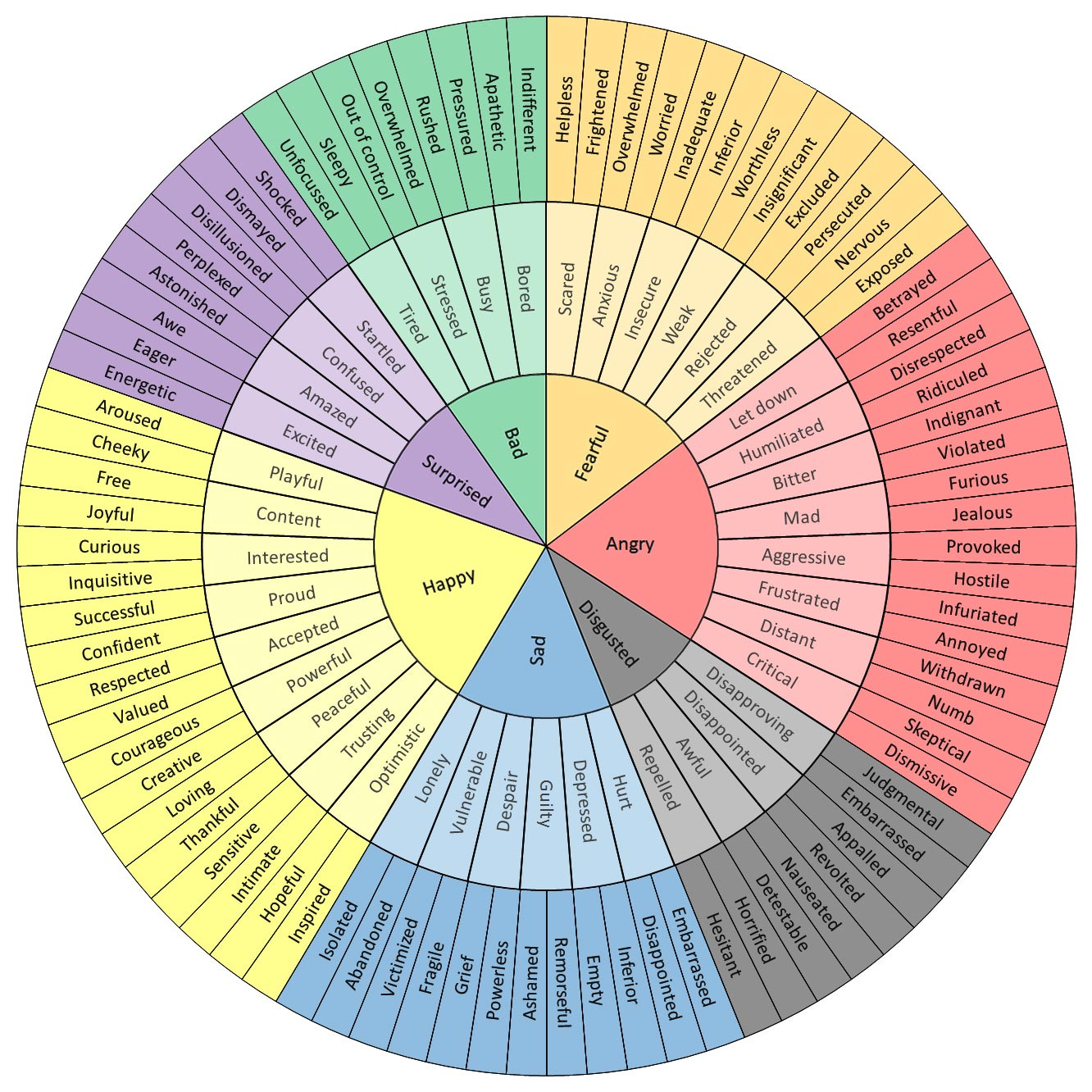
The Feelings Wheel
The Feelings Wheel organizes different dimensions of feelings we may have, into categories and subcategories to help pinpoint exactly how you’re feeling. This can be helpful, especially if you’re overwhelmed by your emotions or in a heated communication.
Why use the Feelings Wheel?
The Feelings Wheel can serve as a guide to understand the intricate web of emotions you feel and their interconnectedness with other emotions. It’s a powerful tool that can help you explore your feelings more deeply and express them more accurately to get the support you need, or simply process whatever emotions you’re navigating.
How to use the Feelings Wheel
The Feelings Wheel serves as more than just a visual representation of emotions; it's a practical tool that empowers individuals to develop their emotional intelligence and re-engage their rational mind. Here's how the Feelings Wheel can be effectively utilized continues at https://www.calm.com/blog/the-feelings-wheel
12 Laws of the Universe
Michael Corthell
Aug 21, 2025
By aligning your inner world, you influence your outer world.

https://michaelcorthell.substack.com/p/the-12-laws-of-the-universe-the-law-52d
Without prejudice and without recourse
Doreen Agostino
Our Greater Destiny Blog
psychology-brain
I just inserted text from ‘The Neuroscience of Letting Go’ posted by Gabriel, into AI Detector app .gptzero .me
The response reads | Chance this entire text is...
AI 100%
Mixed 0%
Human 0%
I will insert a screen shot of the response into my publication.